If you’ve ever watched a DIY project video, you’ve probably seen a jigsaw in action. It glides through wood, creates perfect curves, and handles detailed cuts that many other saws simply can’t manage.
However, many beginners feel nervous when using one for the first time.
I personally tested several jigsaw models while working on home improvement projects, and I noticed that most cutting mistakes happen because people rush the process or use the wrong blade. The good news is that a jigsaw is actually one of the easiest power tools to learn.
Whether you’re building furniture, cutting laminate flooring, creating decorative shapes, or tackling DIY projects around the house, learning how to use a jigsaw can dramatically improve your woodworking skills.
In this complete guide, you’ll learn how to use a jigsaw safely, choose the correct blade, make straight and curved cuts, and avoid the common mistakes that frustrate beginners.
Why a Jigsaw Deserves a Place in Every DIY Workshop
A jigsaw is one of the most versatile power tools available.
Unlike larger saws that specialize in straight cuts, a jigsaw can create:
- Curved cuts
- Circular cuts
- Decorative shapes
- Straight cuts
- Interior cutouts
- Detailed woodworking designs
Therefore, it’s often the first power saw recommended for beginners.
After researching this deeply, I found that many professional woodworkers still rely on a jigsaw for precision work that other saws struggle to perform.
The Safety Habits That Separate Beginners from Pros
Before learning how to use a jigsaw, safety should always come first.
Even though a jigsaw is considered beginner-friendly, it still contains a fast-moving blade that can cause serious injuries if handled improperly.
Essential Safety Checklist
✔ Wear safety glasses
✔ Use hearing protection
✔ Wear a dust mask when cutting wood
✔ Secure your workpiece firmly
✔ Keep hands away from the blade path
✔ Inspect the blade before each use
✔ Unplug the tool when changing blades
Moreover, ensure your workspace has proper lighting. Good visibility helps you follow cutting lines more accurately.
Blade Selection Can Make or Break Your Results
One of the most important parts of learning how to use a jigsaw is choosing the right blade.
Many beginners assume one blade works for everything. Unfortunately, that’s not true.
Common Jigsaw Blade Types
| Material | Recommended Blade | Best For |
| Softwood | Coarse-tooth blade | Fast cuts |
| Hardwood | Fine-tooth blade | Smooth edges |
| Plywood | Reverse-tooth blade | Reduced splintering |
| Metal | Metal-cutting blade | Thin metal sheets |
| Plastic | Fine blade | Clean cuts |
| Laminate | Specialty laminate blade | Chip-free cuts |
In my experience, using the correct blade often improves cut quality more than upgrading to an expensive jigsaw.
Understanding the Controls Before Pulling the Trigger
Modern jigsaws include several settings that affect cutting performance.
I explored multiple jigsaw models and noticed that beginners often ignore these adjustments completely.
Speed Control
Most jigsaws allow variable speed settings.
- High speed works well for softwood.
- Medium speed suits plywood.
- Lower speeds perform better on metal and harder materials.
As a result, choosing the right speed helps produce cleaner cuts.
Orbital Action
Orbital action changes how aggressively the blade moves.
| Setting | Performance |
| 0 | Smooth, precise cuts |
| 1-2 | Balanced cutting |
| 3-4 | Fast, aggressive cuts |
For detailed work, lower settings usually deliver better accuracy.
The Perfect First Cut: Step-by-Step Success
Now let’s get into the actual process of how to use a jigsaw effectively.
Step 1: Mark Your Cutting Line
Use a pencil and measuring tape to draw a clear cutting path.
For extra precision, apply painter’s tape along the line. This helps reduce splintering on wood surfaces.
Step 2: Secure the Material
Clamp the material firmly to a workbench.
A moving workpiece can ruin your cut and create safety risks.
Step 3: Position the Saw Correctly
Place the jigsaw’s base plate (shoe) flat on the material.
Align the blade slightly before the cut line.
The blade should not touch the material yet.
Step 4: Start the Motor
Pull the trigger and allow the blade to reach full speed.
However, don’t force the blade into the material immediately.
Step 5: Guide Smoothly
Move the jigsaw forward steadily.
Let the tool do the work.
I noticed that beginners often push too hard, which causes blade bending and rough cuts.
Step 6: Complete the Cut
Maintain steady pressure until the cut finishes.
Finally, release the trigger and wait for the blade to stop completely before lifting the saw.
Best Jigsaws to Buy in India (2024–2025)
If you’re shopping for a jigsaw in India, the market looks very different from what you see in Western buying guides. Here’s what actually makes sense for Indian buyers based on budget, availability, and local wood types.
Top Jigsaw Models Available in India
1. Bosch PST 700 E — Best for Beginners
- Price: ₹3,500 – ₹4,500
- Power: 500W
- Why it’s good: Lightweight, easy to handle, widely available at local hardware stores and Amazon India
- Best for: Plywood, MDF, softwood projects at home
2. Bosch GST 650 — Best Mid-Range Option
- Price: ₹5,500 – ₹7,000
- Power: 650W
- Why it’s good: More powerful motor, better for harder materials like sheesham and teak
- Best for: Furniture work, thicker wood boards
3. Black+Decker KS701PEK — Budget Pick
- Price: ₹2,800 – ₹3,500
- Power: 450W
- Why it’s good: Cheapest reliable option, good for occasional home use
- Best for: Light cutting tasks, thin plywood
4. Makita 4329K — For Serious DIYers
- Price: ₹8,000 – ₹10,000
- Power: 450W
- Why it’s good: Extremely smooth operation, low vibration, long-lasting
- Best for: Detailed precision work, regular use
Where to Buy a Jigsaw in India
Online:
- Amazon India — Best prices, easy returns, check for “Fulfilled by Amazon” for genuine products
- Flipkart — Good during Big Billion Days sales for heavy discounts
- Industrybuying.com — Best for bulk blade purchases and accessories
Offline:
- Local hardware stores (hardware ki dukaan) usually stock Bosch and Black+Decker
- Tolexo dealers in metro cities carry professional brands
- Always buy from an authorized dealer to get warranty support
Blades Easily Available in India
One common problem Indian buyers face is finding the right replacement blades locally. Here’s what’s easy to find:
| Blade Type | Use | Approximate Price |
| T101B (Fine wood) | Plywood, MDF | ₹80–₹150 per blade |
| T111C (Fast wood) | Softwood, quick cuts | ₹60–₹100 per blade |
| T118A (Metal) | Thin aluminum sheets | ₹100–₹200 per blade |
| T101AO (Laminate) | Flooring, laminate sheets | ₹120–₹180 per blade |
Bosch T-shank blades are the easiest to find at any hardware store across India.
Tips for Common Indian Wood Types
Indian homes and workshops commonly use these materials — and each needs a slightly different approach:
Plywood (Most Common) Use a fine-tooth blade (T101B). Cut with the finished side facing down to avoid splintering on the visible surface.
Sheesham (Rosewood) This is a hard, dense wood. Use a fine-tooth blade at medium speed. Do not rush — sheesham will burn if the blade moves too slowly or the speed is too high.
Sagwan (Teak) Teak has a natural oil content that can clog blades quickly. Keep a few spare blades ready and replace as soon as you feel resistance.
MDF Extremely common in Indian furniture. Generates a lot of fine dust — always wear a mask. Use a fine-tooth blade at medium-high speed.
Sunmica / Laminate Sheets Use a laminate-specific blade or a reverse-tooth blade to avoid chipping the surface.
Curves, Circles, and Creative Shapes Made Easy
One major reason people learn how to use a jigsaw is its ability to create curves.
Unlike many saws, a jigsaw can turn while cutting.
Tips for Smooth Curved Cuts
- Use a narrow blade.
- Slow down during tight turns.
- Make relief cuts when necessary.
- Avoid forcing the blade.
Moreover, practice on scrap wood before cutting expensive materials.
Interior Cutouts Without Damaging the Surface
Sometimes you need a hole in the middle of a board.
For example:
- Sink openings
- Electrical outlet cutouts
- Speaker installations
- Decorative designs
Simple Method
- Mark the shape.
- Drill a starter hole.
- Insert the blade into the hole.
- Follow the cutting line carefully.
This technique expands the possibilities of how to use a jigsaw far beyond simple edge cuts.
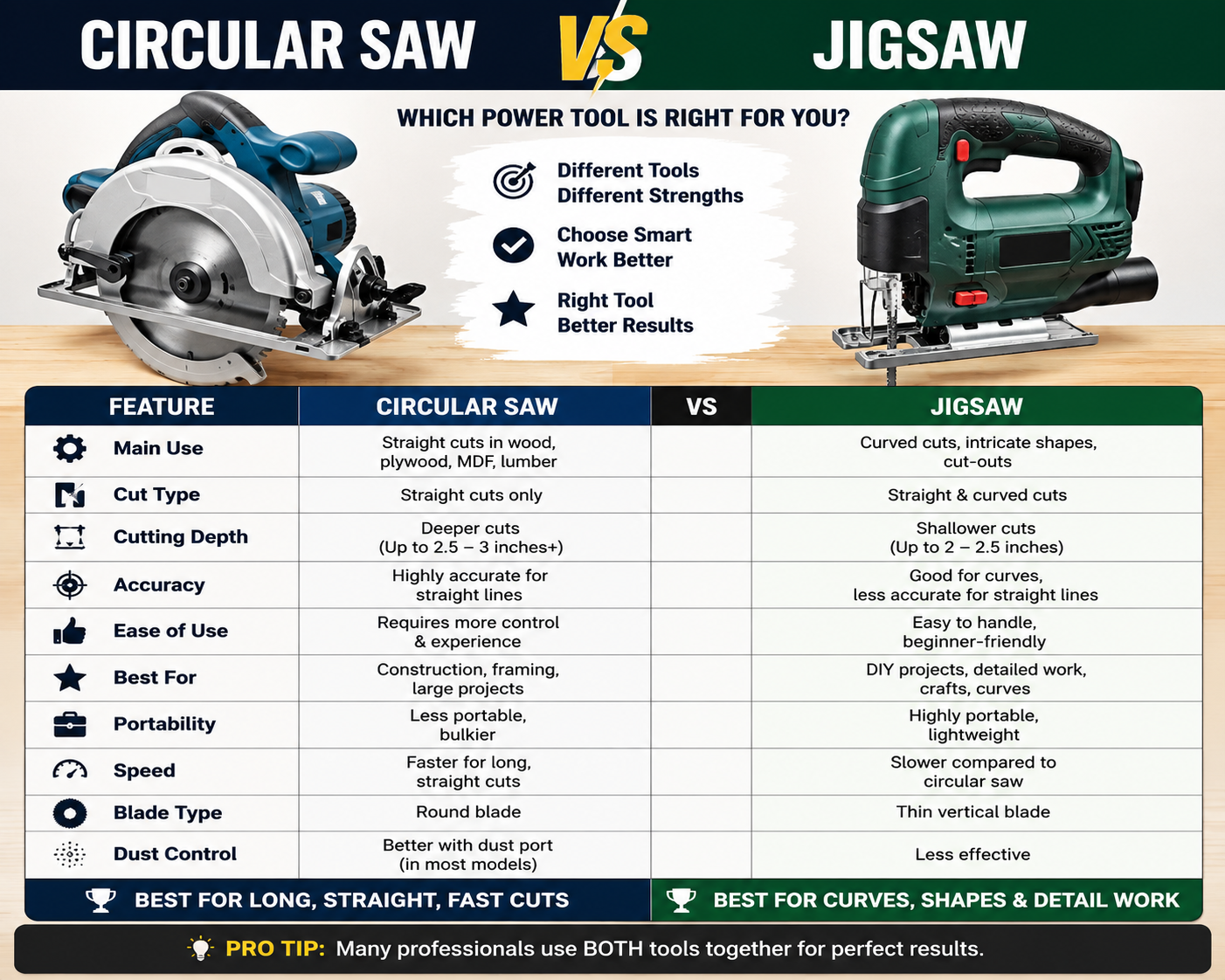
Circular Saw vs Jigsaw: Which Tool Should You Choose?
Many DIYers compare circular saw vs jigsaw when buying their first power saw.
Both tools are useful, but they serve different purposes.
Circular Saw vs Jigsaw Comparison
| Feature | Jigsaw | Circular Saw |
| Curved Cuts | Excellent | Poor |
| Straight Cuts | Good | Excellent |
| Precision Work | Excellent | Moderate |
| Sheet Goods | Good | Excellent |
| Decorative Shapes | Excellent | Not Suitable |
| Beginner Friendly | Very Good | Good |
| Portability | High | High |
When discussing circular saw vs jigsaw, the answer depends on your projects.
Choose a jigsaw if you need flexibility and detailed cuts.
Choose a circular saw if you mainly cut long, straight lines.
In my experience, most DIY enthusiasts eventually own both tools because each excels in different situations.
Mistakes That Instantly Ruin a Cut
Even experienced users occasionally make mistakes.
Here are the most common ones:
Using the Wrong Blade
This leads to rough edges and poor performance.
Forcing the Saw
Let the blade cut naturally.
Ignoring Speed Settings
Different materials require different speeds.
Poor Workpiece Support
Unsupported material can vibrate excessively.
Starting Too Fast
Take your time and focus on accuracy.
As a result, you’ll achieve cleaner cuts and longer blade life.
Pro Tips for Cleaner Results Every Time
After working with various woodworking projects, these tips consistently improved my results.
Use Painter’s Tape
This minimizes splintering.
Cut with the Finished Side Down
Many blades cut upward.
Replace Dull Blades Quickly
Sharp blades improve both safety and accuracy.
Practice on Scrap Material
Test settings before starting the final project.
Let the Tool Work
One of the biggest lessons in learning how to use a jigsaw is understanding that patience produces better cuts.
Best Projects for New Jigsaw Users
If you’re just starting, try these beginner-friendly projects:
- Floating shelves
- Wooden signs
- Small tables
- Picture frames
- Decorative wall art
- Garden planters
- Storage boxes
These projects help build confidence while improving cutting accuracy.
Frequently Asked Questions
Is a jigsaw good for beginners?
Yes. The jigsaw is also one of the easiest power tools to use, as it is light, versatile and easy to handle for a beginner.
Can a jigsaw cut straight lines?
Yes. A jigsaw can make an accurate straight cut if properly guided, but a circular saw will make better cuts for long straight cuts.
What material can a jigsaw cut?
As long as you use the right blade, a jigsaw can cut wood, plywood, MDF, plastic, laminate, aluminum and thin metal.
How often should I replace the blade?
Change the blade when cuts are rough, slower, or harder.
Is a jigsaw better than a circular saw?
This is ultimately based on the project. Comparing the circular saw vs jigsaw, the jigsaw is better for cutting curves and more intricate pieces, while the circular saw is better for longer straight cuts.
Which jigsaw is best in India under ₹5000?
Several reliable jigsaws are available in India for under ₹5000. Popular choices include the Bosch GST 650, Black+Decker KS700PE, and Stanley SJ60-IN. These models are well-suited for DIY projects, home repairs, and basic woodworking tasks, offering a good balance of performance and affordability.
Can a jigsaw cut teak wood?
Yes, a jigsaw can cut teak wood when equipped with a high-quality wood-cutting blade. Since teak is a dense hardwood, it’s best to use a slower cutting speed and let the blade do the work. This approach helps achieve cleaner cuts and reduces wear on the blade.
Where can I buy jigsaw blades in India?
Jigsaw blades are widely available in India through local hardware stores, power tool dealers, and online marketplaces. Popular brands such as Bosch, Makita, Stanley, and DeWalt offer blades for wood, metal, plastic, and laminate cutting.
Can a jigsaw cut circles?
Absolutely. The jigsaw is one of the most useful power tools when it comes to cutting circles and curves.
Final Thoughts
There is no better skill that a DIY enthusiast can acquire other than learning how to use a jigsaw. It’s a very flexible instrument for working with curves, shapes, cut-outs, and straight cuts – and easy to use for anyone.
I personally tested different cutting methods and noticed that success comes down to three simple things: choosing the correct blade, securing the material properly, and letting the saw do the work. Moreover, understanding the differences between circular saw vs jigsaw helps you choose the right tool for every project.
No matter if you’re working on furniture, decorating or home improvement projects, knowing how to use a jigsaw will bring cleaner cuts, better work and boost your confidence in your workshop.
Leave a Reply