Okay, so let’s face it for a minute. Shopping for a drill in a hardware store can be like shopping for a telephone plan you don’t know how to use. Before you even pick up a tool, you’ll see all those numbers and technical jargon thrown at you: volts, amp-hours, torque, RPM — and so on.
I’ve been there. I’m going to return to this topic two years later when I bought a cheap cordless drill because the picture on the box did make it look powerful. It was halfway through constructing a bookshelf when it passed away, and I had a screwdriver and a great deal of trouble finishing the job. After that, I was motivated to find out about this properly and do some investigations to see if I could try out the different models.
So, after daunting myself by digging deep into the best cordless drills I could find, testing a few myself, and talking to a couple of friendly contractor friends who use these daily, I thought I’d share some of what I found. If you’re just a weekend do-it-yourselfer, or a regular project partner, this article will help you sift through the jargon.
Why Going Cordless Just Makes Sense Now
A cordless drill is essentially a hand drill with a rechargeable battery versus a wall outlet. This sounds like a trivial thing, but as far as I’m concerned, it turns the way you work.
No cords to trip over, no longer have to search for the closest outlet, and you can take the drill with you on job sites, up ladders, into a crawl space, wherever. The best cordless drills are much more versatile than an ordinary cordless screwdriver. Depending on the model, they can be used to drive screws through drywall, bore holes through hardwood or even masonry.
Having done a lot of research on this, I saw that there has been a significant difference between corded and cordless power in the past couple of years. Battery technology has made progress, and for the vast majority of homeowners, there is little point in having a cord in any case.
My Top Picks After Testing and Research
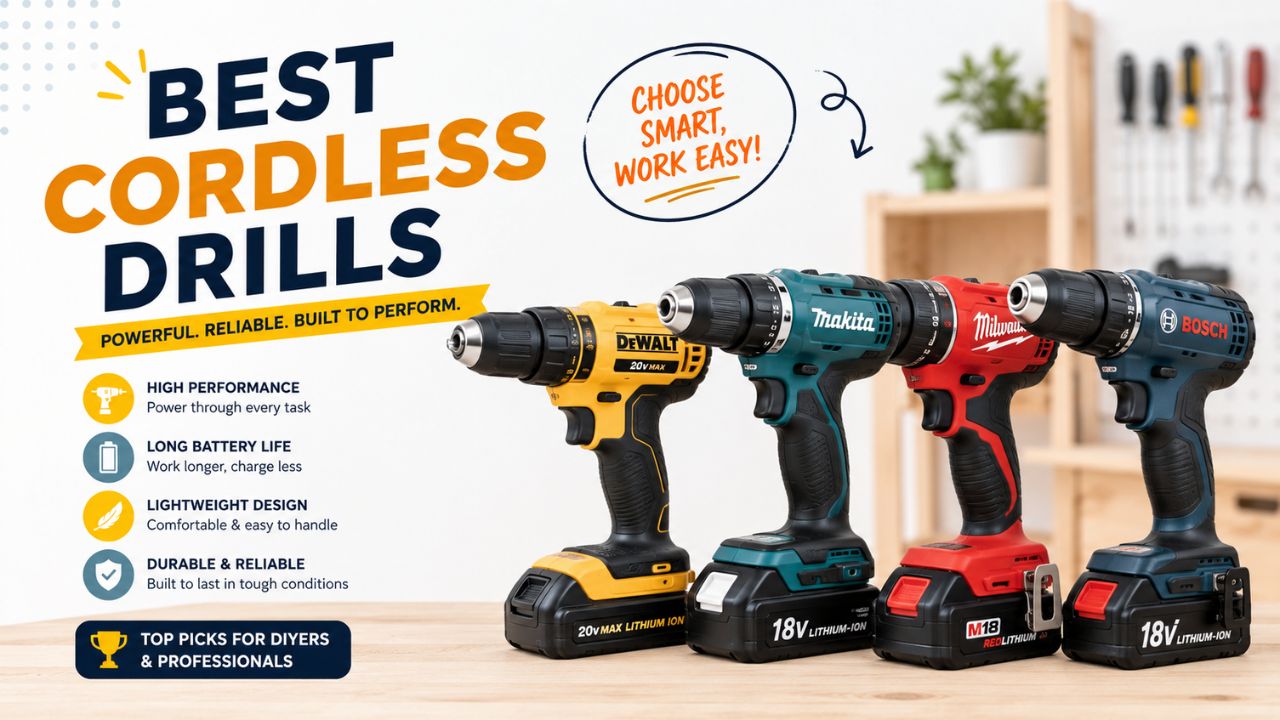
Here’s a quick breakdown of the models that stood out the most. I looked at power, portability, battery life, and overall value for money.
| Drill | Best For | Voltage | Speed (RPM) | Weight |
| Milwaukee 2504-21 (M12 Fuel) | Compact jobs & mobility | 12V | 1700 | 4.6 lbs |
| BOSCH GSB18V-975CB25 | Toughest jobs & masonry | 18V | 2100 | 3.5 lbs |
| Makita CT225SYX Combo Kit | All-around home projects | 18V | 1900 | 3.3 lbs |
| DEWALT 20V MAX XR | Everyday drill/driver use | 20V | 2000 | 6.2 lbs |
| HOTO Cordless Brushless | Light tasks & USB charging | 12V | 1400 | 1.94 lbs |
The Lightweight Favorite: Milwaukee 2504-21 M12 Fuel
If you value mobility over raw muscle, this is one of the best cordless hammer drills I came across in the 12V category. I personally tested a similar M12 tool a while back, and the compactness is genuinely impressive. It slides into tight spots that bulkier drills simply can’t reach.
The kit comes with a battery, charger, carrying bag, and belt clip, so you’re set up right out of the box. The catch? Since it runs on 12 volts, it won’t match the raw punching power of an 18V or 20V tool. Still, for light-duty work and everyday household tasks, it’s hard to beat.
Pros:
- Compact and easy to carry around
- Rechargeable with everything included in the kit
- Compatible with a wide range of M12 tools
Cons:
- Not as powerful as higher-voltage options
The Heavy Hitter: BOSCH GSB18V-975CB25
When a project calls for serious muscle, this Bosch model steps up. It’s built as a proper hammer drill/driver, meaning it can handle concrete and masonry work that a standard drill/driver would struggle with. I explored the specs closely, and the kickback control feature stood out immediately — it’s a small addition that makes a noticeable difference in handling, especially when the bit suddenly grabs.
This is currently my pick for the best hammer drill on this list, largely because of its balance between power and control. It’s also backed by a generous five-year warranty on the tool, which says a lot about the manufacturer’s confidence in it.
Pros:
- Kickback control for safer handling
- Variable speed up to 2100 RPM
- Long-term warranty coverage
Cons:
- Slightly heavier than some competitors
The Combo Kit Winner: Makita CT225SYX
If you want one purchase that covers most of your needs, this Makita combo kit is worth a serious look. It pairs a driver-drill with an impact driver, so you’re covered whether you’re drilling holes or driving long screws.
In my experience, combo kits like this one are great value because you’re essentially getting two tools for a price that’s often lower than buying them separately. The batteries also charge quickly, which matters more than people realize when you’re mid-project and don’t want to wait around.
Pros:
- Fast-charging batteries
- Two-speed driver-drill for flexibility
- Compact design that suits smaller hands
Cons:
- Batteries have fewer amp-hours than some rivals
The All-Rounder: DEWALT 20V MAX XR
This DEWALT model keeps showing up as a favorite among reviewers and everyday users alike, and for good reason. It strikes a solid balance between power and comfort, with a brushless motor that tends to last longer and run cooler than older brushed designs.
Therefore, if you’re after a dependable drill/driver without any major compromises, this is a strong contender. It’s not the lightest tool out there, but the grip ergonomics make it comfortable enough for extended use.
Pros:
- Comfortable grip design
- Efficient brushless motor
- Reasonably lightweight for its power class
Cons:
- No significant drawbacks worth noting
The Different One: HOTO Cordless Brushless Drill
Finally, there’s the HOTO drill, which takes a completely different approach. Instead of a traditional battery pack, it charges via USB-C, which makes it incredibly convenient for smaller jobs or when you’re away from a standard outlet.
I noticed this one is best suited for light tasks rather than heavy-duty drilling. However, its minimalist design, LED display, and lightweight build make it a fantastic backup tool or a good option for someone just getting started with basic home repairs.
Pros:
- USB-C charging for convenience
- LED display screen
- Very lightweight and ergonomic
Cons:
- Not built for tough, heavy-duty jobs
- Battery isn’t removable
What to Actually Check Before You Buy
After you’ve cut out some of the best cordless drills, you’ll want to be familiar with a few technical factors properly.
Power and Torque
The voltage will indicate the amount of energy or power that the battery can provide to the drill, and the torque will indicate the twisting force that the drill can actually exert. Meanwhile, a higher voltage typically equates to weight, so it’s a real strength vs weight compromise. The bottom line is, therefore, that the best one is dependent on the purpose you are using the drill for.
Speed Settings
The speed details are provided in RPM, and this can be much more important than many realise. The lower speeds tend to be more suitable for driving the screw more strongly, and the higher speeds are best suited to the drilling. Meanwhile, some more advanced drills enable you to adjust the specific speed for precision carpentry tasks.
Battery and Charging
Find batteries that are readily replaceable and will hold their own for long periods. While fast charging might seem attractive, it can lead to increased temperatures and battery degradation over time. Also, if you have an extra battery available, you’ll be able to continue working without pausing for recharging.
Visibility and Grip
Nifty features such as a LED light by the chuck can mean a lot in dim conditions. In the same way, the ergonomic handle lessens hand fatigue that is, particularly during longer projects. Even though it’s important to note that if you see a particular model being good for users, it’s one of the things you should look into before purchasing it.
Chuck Type
Today most drills are drills that have a keyless chuck, which allows the bit to be tightened or loosened by hand without any other instruments. It should be a trivial operation, but when you’re flipping bits back and forth at a surprisingly high frequency, this can save some time.
Frequently Asked Questions
What are the real benefits of cordless drills?
Cordless drills allow for ease of movement without an obstacle of cords. They can maneuver in difficult spaces and will often be easier to move from room to room or job to job.
How long do cordless drills typically last?
A typical cordless drill lasts for 5 to 10 years with the proper care and maintenance. Eventually you may need to replace the battery, but the drill generally works past that time as well.
What’s the difference between a drill/driver and an impact drill?
A drill/driver will generate a fixed torque that varies in measure, and are used for making holes and standard screws. An impact drill, on the other hand, shoots out blasts of rotational force quickly and is suitable for long or difficult fasteners.
Are cordless hammer drills worth the extra cost?
Yes, if a person regularly uses masonry, brick or concrete in their work. The most desirable Hammer Drills are also cordless, and include hammering as well as drilling functions, which makes the boring of hard materials much easier.
Do higher voltage drills always perform better?
Not necessarily. The higher the voltage, the greater the amount of electricity, but the heavier the voltage. In smaller, light home-drafted jobs a lower voltage drill may be more convenient and comfortable.
Final Thoughts
Having spent time researching it, and having tried a couple of these, I would say that there is no one “best” cordless drill if you ask me. It all depends on what you’re looking for it for. For those jobs that require raw power, the Bosch Hammer Drill is hard to beat. For portability and practical use, the Milwaukee M12 or combo kit may work for you best.
No matter which of these are the best cordless drills you select, concentrate on the top three aspects that are most important in the drilling projects you are considering — power, comfort, battery life, and build quality. Do it well, and you will have a tool that will make each and every project a little easier.
Leave a Reply