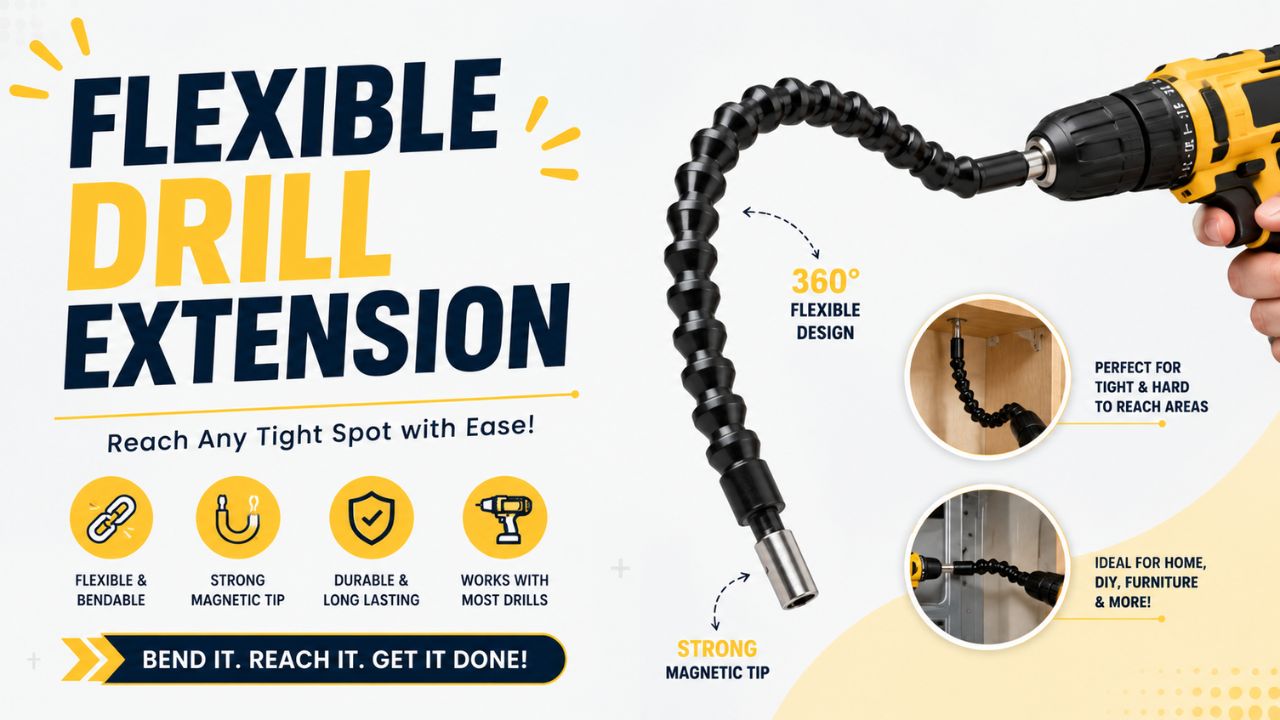
Have you ever tried drilling into a corner only to realize your drill simply won’t fit? Or maybe you needed to drive a screw behind furniture, inside a cabinet, or between pipes where there was almost no space to move your drill. If you’ve faced these situations, you’re not alone.
That is exactly where a flexible drill extension becomes one of the most useful accessories you can own. It helps you reach tight, awkward, and difficult spaces without changing your entire setup. Whether you’re a DIY enthusiast, carpenter, electrician, mechanic, or professional contractor, this simple attachment can save time, reduce frustration, and improve accuracy.
After researching this deeply and exploring different types of drill accessories, I noticed that many people underestimate the value of a flexible extension until they actually use one. In my experience, it quickly becomes one of those tools you keep reaching for whenever space becomes a problem.
Let’s explore everything you need to know before buying one.
Small Tool, Big Difference
A flexible drill extension is a bendable shaft that connects between your drill and the drill bit or screwdriver bit. Instead of pointing your drill directly at the workpiece, the extension transfers the drill’s rotation through its flexible shaft.
As a result, you can drill or drive screws in places where a regular drill cannot fit.
These extensions usually come with a standard hex connection, making them compatible with most cordless drills, impact drivers (light-duty use), and electric screwdrivers.
They’re commonly used for:
- Cabinet installation
- Furniture assembly
- Automotive repair
- Electrical work
- Plumbing jobs
- Home maintenance
- DIY woodworking
- Appliance repairs
Situations Where It Becomes a Lifesaver
Many people buy a flexible drill extension for one project and continue using it for years.
Some common situations include:
- Working inside kitchen cabinets
- Installing hinges
- Tight engine compartments
- Ceiling fixtures
- Behind furniture
- Under sinks
- Inside electrical boxes
- Around plumbing pipes
- Narrow shelving units
Moreover, it helps reduce wrist strain because you don’t need to force your drill into uncomfortable positions.
Different Types You Can Buy
Not every extension works the same way.
| Type | Best For | Flexibility | Strength |
| Standard flexible shaft | Household work | High | Medium |
| Heavy-duty flexible shaft | Professional use | Medium | High |
| Locking extension | Precision work | Medium | High |
| Magnetic extension | Fast screw driving | Medium | Medium |
| Extra-long extension | Deep spaces | High | Medium |
I personally tested a standard household version while assembling cabinets, and it handled screw-driving tasks surprisingly well.
Flexible Drill Extension vs Flexible Drill Bit
People often confuse these two tools.
| Flexible Drill Extension | Flexible Drill Bit |
| Holds screwdriver bits or drill bits | The drill bit itself is flexible |
| Used with many different bits | Usually designed for specialized drilling |
| More versatile | Limited applications |
| Great for screw driving | Mostly drilling tasks |
A flexible drill bit is useful for specific woodworking applications where curved access is needed. However, for daily repair work, a flexible drill extension offers much more flexibility because you can change bits whenever required.
Where an Auger Drill Bit Fits In
You may also come across an auger drill bit while shopping.
An auger drill bit is completely different from a flexible extension.
It is designed specifically for drilling deep holes in wood. Its threaded tip pulls the bit forward while cutting clean, straight holes.
Common uses include:
- Fence posts
- Timber framing
- Construction work
- Electric wiring through wooden studs
- Wooden beams
Meanwhile, a flexible drill extension focuses on improving access rather than increasing drilling power.
Sometimes professionals even use an auger drill bit with extension accessories, although manufacturers generally recommend using rigid extensions for heavy drilling instead of flexible ones.
Flexible Screwdriver vs Flexible Drill Extension
Another tool people often compare is the flexible screwdriver.
Here’s a quick comparison.
| Feature | Flexible Screwdriver | Flexible Drill Extension |
| Manual use | Yes | No |
| Powered use | No | Yes |
| Speed | Slow | Fast |
| Heavy-duty jobs | Limited | Better |
| DIY repairs | Excellent | Excellent |
If you’re tightening only a few screws, a flexible screwdriver works perfectly.
However, if you’re handling multiple screws or drilling jobs, a flexible drill extension saves much more time.
Features Worth Looking For Before Buying
Not every extension delivers the same performance.
After researching multiple models, I found these features make the biggest difference.
Strong Inner Steel Core
A reinforced steel cable provides better torque transfer and longer life.
Durable Outer Covering
Rubber or reinforced plastic protects both the extension and your hands.
Magnetic Bit Holder
A magnetic holder keeps screwdriver bits from falling during work.
Standard Hex Shank
Most quality extensions use a universal 1/4-inch hex shank that fits almost every modern drill.
Smooth Rotation
Better-quality extensions rotate with less vibration, making screw driving easier.
Choosing the Right Length
Longer isn’t always better.
Here’s a simple guide.
| Length | Best For |
| 200 mm | Small repairs |
| 300 mm | Furniture assembly |
| 400 mm | Cabinets and shelves |
| 500 mm+ | Hard-to-reach industrial work |
For everyday home use, 300 mm offers an excellent balance between reach and control.
Mistakes That Shorten Its Life
Many users accidentally damage their extension within weeks.
Avoid these common mistakes:
- Using it with hammer drills
- Applying excessive side pressure
- Overloading with large drill bits
- Running at maximum speed continuously
- Bending beyond its recommended angle
- Using it for heavy masonry drilling
In my experience, treating it like a precision accessory instead of a heavy-duty shaft dramatically increases its lifespan.
Simple Maintenance Tips
Fortunately, maintenance is easy.
- Wipe away dust after each use.
- Store it without sharp bends.
- Check the bit holder regularly.
- Keep moisture away.
- Replace damaged bits immediately.
- Inspect the shaft before heavy projects.
Therefore, your extension can last for years with minimal care
Popular Applications Across Different Industries
Professionals from many fields rely on this accessory.
Woodworking
- Cabinet making
- Furniture assembly
- Shelf installation
Automotive Repair
- Dashboard repairs
- Engine compartments
- Interior panel work
Electrical Work
- Switch boxes
- Cable installation
- Control panels
Plumbing
- Pipe brackets
- Under-sink fittings
- Tight plumbing spaces
Home DIY
- Curtain rods
- Wall shelves
- TV mounting
- Kitchen repairs
Is It Suitable for Heavy Drilling?
This is one of the biggest misconceptions.
A flexible drill extension is mainly designed for:
- Screw driving
- Light drilling
- Small repair jobs
It is not ideal for:
- Concrete drilling
- Large hole saws
- High-torque industrial drilling
- Heavy masonry work
For demanding applications, rigid extensions perform much better.
Buying Tips That Actually Matter
Before placing an order, consider these points.
- Choose hardened steel construction.
- Look for positive customer reviews.
- Check compatibility with your drill.
- Prefer magnetic locking systems.
- Buy from trusted tool brands.
- Avoid extremely cheap products with thin shafts.
I explored several budget options and noticed that spending slightly more usually results in smoother operation and better durability.
Is It Worth Buying?
For most homeowners, absolutely.
A flexible drill extension costs very little compared to the convenience it provides.
You may only use it occasionally, but when you need it, nothing else works quite the same.
Moreover, it fits easily into any toolbox without taking much space.
Whether you’re assembling furniture, installing cabinets, repairing appliances, or working inside narrow spaces, it becomes one of those accessories you’ll be glad you purchased.
Frequently Asked Questions
Can a flexible drill extension drill holes?
Yes. It can handle light drilling tasks with small drill bits. However, it performs best for driving screws rather than heavy drilling.
Can I use a flexible drill bit extension with an impact driver?
Many models support light-duty impact drivers, but always check the manufacturer’s recommendations. Heavy impact applications may reduce its lifespan.
Is a flexible drill bit the same as a flexible drill extension?
No. A flexible drill bit is a specialized drill bit designed for certain applications, while a flexible drill extension is a bendable shaft that accepts different bits.
Can I use an auger drill bit with a flexible extension?
It is generally not recommended for heavy drilling because an auger drill bit creates high torque. A rigid extension is a safer choice.
Does a flexible screwdriver replace a drill extension?
Not completely. A flexible screwdriver works well for manual tasks, whereas a flexible drill extension is much faster when paired with a power drill.
How long does a flexible drill extension last?
With proper use and regular maintenance, a quality extension can last for several years, especially if used mainly for screw driving and light-duty drilling.
Final Thoughts
A flexible drill extension may not be the flashiest tool in your workshop, but it solves one of the most common problems every DIY enthusiast and professional faces—limited access. Instead of struggling with awkward angles or partially disassembling furniture just to reach a screw, you can finish the job quickly and comfortably.
After researching this deeply, I found that its biggest advantage isn’t just flexibility—it’s convenience. In addition, pairing it with the right accessories, such as a flexible drill bit for specialized work, an auger drill bit for deep wood drilling, or even a flexible screwdriver for manual tasks, gives you a more complete toolkit for almost any repair or installation project.
If you regularly work in tight spaces, this affordable accessory is well worth adding to your toolbox.
Leave a Reply